
Guide
Teak decking for boats and yachts
This page is written by people who make teak decks for a living. It covers what sets the cost of a teak deck, how long it lasts, how the construction methods differ, and when a synthetic alternative is the better decision.

01
What teak decking is, and why it is still the standard
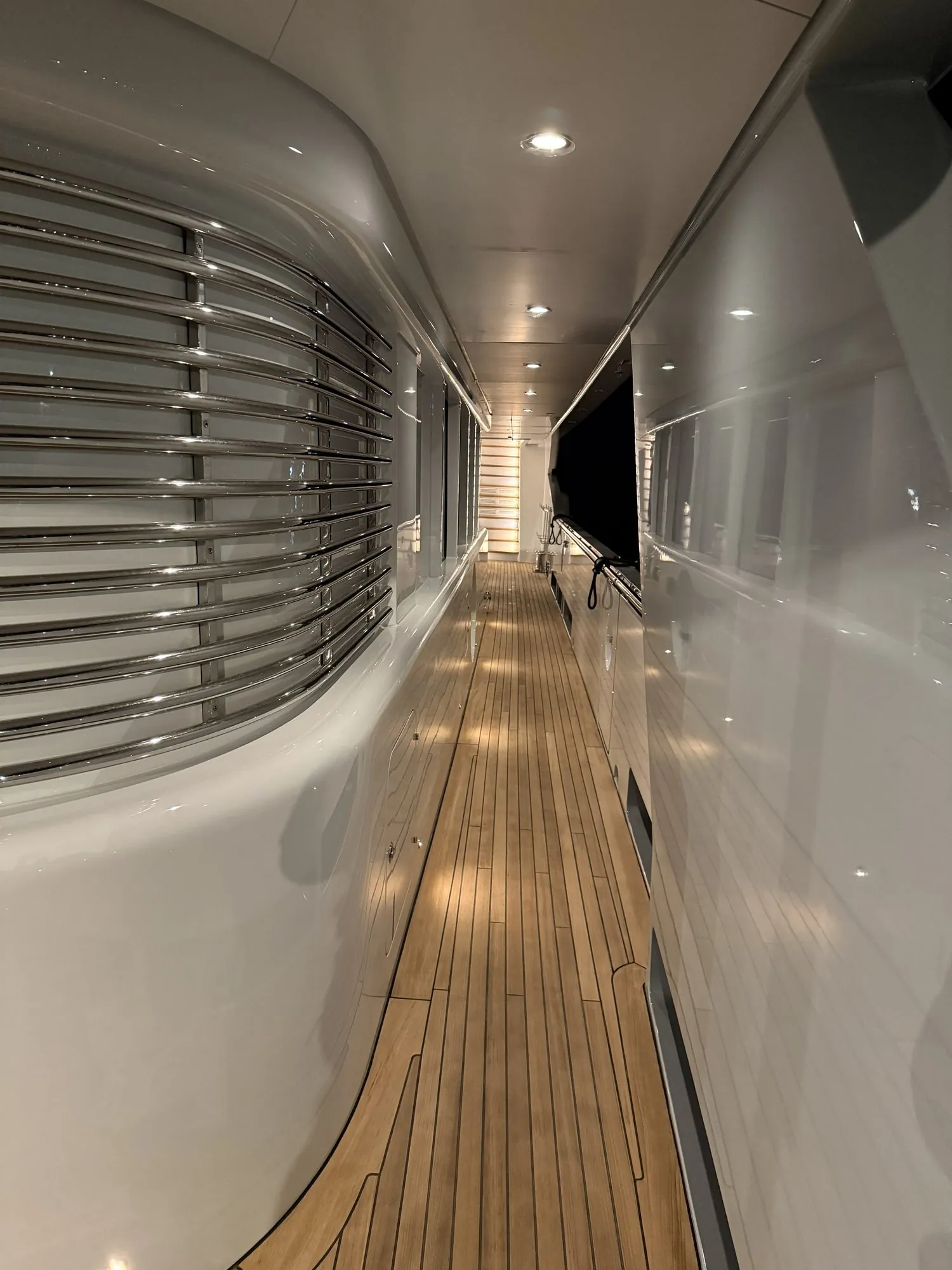
A teak deck is a wearing surface, not a covering. Planks of teak are laid over the structural deck with a flexible caulk seam between them, and the whole assembly exists to be walked on, cleaned, and eventually sanded back to fresh timber.
Teak earned its place through a combination no other timber quite matches. Its natural oil content lets it resist rot without a coating. It holds grip when wet, which is the property that matters most on a moving boat. It moves very little with changes in moisture, so seams stay closed and fastenings stay tight. And it stays cool enough underfoot to stand on in summer, something teak owners notice most on the day they step onto a synthetic deck.
The other half of the answer is renewability. Teak is the only deck surface that can be taken back to new. Sanding removes the weathered layer, and what is underneath is the same timber, unchanged. How many times that can be done is set by thickness, which is why thickness is the number that decides everything else on this page.
It is also why a teak deck is a maintained asset rather than a consumable. Looked after, it outlasts most of what is bolted to it. Neglected, it is finished faster than any other surface on the boat.
02
Types of teak deck
There are three ways to get a teak-looking deck onto a boat, and they are genuinely different products rather than grades of the same one. What separates them is where the work happens: on the boat, in a workshop, or in a factory that never sees your vessel. That changes the cost, the schedule, and what can be repaired later.
Traditionally laid deck
Planks are laid, fitted and caulked on the boat, one at a time. It is the original method and it is still the right one in some situations: a vessel whose deck is not a repeatable shape, a restoration that has to match what was there, a boat where nobody can be sure of the geometry until the old deck is off.
The strength of the method is that it adapts to what it finds. The plank in the hand is fitted to the space in front of it, and nothing depends on a template being right.
The cost of the method is time on the boat. Caulking and sanding happen outdoors, subject to weather, dust and the yard’s schedule, and the vessel is unusable throughout. On a large deck that is weeks of skilled labour in a place where labour is expensive to have standing. It is also the hardest work to quote accurately, because it is discovered rather than planned.

Prefabricated panels
The deck is templated, then built as finished panels in a workshop: planks cut to the vessel’s geometry, caulked, cured and sanded flat under controlled conditions, then delivered ready to bond down.
What changes is where the difficult work happens. Caulk cures properly at a known temperature. Sanding is done on a bench with the panel flat, not on hands and knees on a curved deck. Waste is cut before the material is on the boat rather than after. The vessel’s involvement shrinks to templating and fitting, which is the difference between a deck that occupies a boat for weeks and one that occupies it for days.
The risk moves to the template. A panel is cut to the template, not to the boat, so an error in measurement is reproduced exactly and at full size. Everything else about the method is easier; that one thing is less forgiving. How we build the panels.

Synthetic and composite alternatives
Synthetic decking is a manufactured sheet or plank, usually PVC or a polymer composite, moulded and coloured to read as teak from a few metres away, with a printed or extruded seam standing in for caulk.
It is not a cheap imitation of teak so much as a different product with a different logic. It does not need maintaining, does not stain, does not grey, and arrives the colour it will stay. In exchange it cannot be renewed: wear is permanent, and when a synthetic deck is finished the answer is a new one. It also runs hotter in the sun than teak does, which on a Mediterranean afternoon is not a small difference.
We make real teak, so treat our view accordingly. There are still boats where we would tell an owner to buy synthetic, and we have written those cases out in full rather than leaving them implied.
03
How much does a teak deck cost?
It is project-dependent. We do not publish a price per square metre, because the size of a deck says less about its cost than the deck itself does.
What moves a quote is the shapes: a deck of long, gentle runs cuts efficiently, while one broken up by hatches, fittings and tight margins wastes material and takes far longer to template. It is the frames: the quantity of margin, king plank and covering board, which is detail work. It is the thickness of the teak, which sets how much material is in the deck and how many sandings it will allow, and the width of the planks and the seams. And it is the substrate, which nobody can price until the old deck is off.
The grade of the teak moves it too. We work in three grades (FEQ, QS and Superyacht), sorted by how clean the timber is: how even the colour, how straight and close the grain, how free of marks and variation. The grade shows in how uniform the finished deck reads, and in the quote.
That last one is why a deck quote should arrive in two parts. The first is firm: panels, material, fitting labour on a sound deck. The second is a contingency for what the survey finds underneath, and it should be written down rather than discovered.
Be careful comparing quotes on price per square metre alone. A thinner deck is cheaper per square metre and shorter-lived in the same proportion, so two quotes that look a third apart may cost the same per year of service. Ask for the thickness alongside the price, every time.
Supply-only is the cheaper route for a yard that can bond a deck properly. For anyone who cannot, it is a false saving.
04
How long does a teak deck last?

Long enough that the question is really about maintenance rather than about teak.
A deck’s life is set by the thickness of teak that can still be sanded. Every sanding takes a fraction of it, and when the sanding reaches the bottom of the caulk seam the deck is done, however sound the timber still looks. A thick deck sanded rarely will outlive a thin deck sanded often by a wide margin. The arithmetic is that simple.
Which is why the depth of the seam matters as much as the thickness of the plank. We cut our seams through the full thickness of the teak, so the caulk holds until the last millimetre of wood and every millimetre can be sanded. Not every deck is built that way: on many, the seam stops short of the full thickness, and the teak below it is never used.
What actually kills decks early is not wear. It is water getting under the planks: caulk that lifted and was not repaired, fittings bedded badly, screw holes left to weep, deck drains that stopped draining. In each case the teak on top can still be in good condition while the substrate underneath has failed, and the substrate decides whether the deck stays.
So the honest answer has two halves. The teak lasts as long as its thickness and its sanding history allow. The deck lasts as long as nothing gets under it.
Two habits buy more years than anything else: repair a seam while it is still a seam problem, and resist sanding to a schedule. Neither costs much. Both are routinely skipped, which is why most decks that come off could have stayed on.

05
Construction details that decide the lifespan
Three decisions, taken before anything is cut, that set what the deck can do for the next twenty years. None of them is visible once the deck is down, which is why they are worth asking about while you still can.
Teak thickness and plank width
Thickness is the most consequential number in a teak deck. Standard options run 6, 8, 10, 12, 16 and 20 mm, and more where a project calls for it; plank widths run from 30 to 90 mm.
Thickness is your sanding budget. A thicker deck costs more at the outset and returns it in service life, and the difference between the thinnest and the thickest option is not a percentage but a multiple.
Width is mostly appearance, with one practical consequence. Narrower planks mean more seams, which means more grip and more caulk to maintain. Wider planks read cleaner and give a little less grip. Traditional yacht decks tend narrow; modern motor yachts tend wide. If a quote does not state the thickness, it is not a quote. It is a number.
Glued versus screwed
Older decks were screwed down and the screws hidden under teak plugs. It works, and there are a great many decks still doing it. But every screw is a hole through the deck into the structure, and every plug is a place where water can eventually get in. When a screwed deck fails, it usually fails around the fasteners.
A bonded deck has no penetrations. The panel is held by the adhesive bed across its whole area, which spreads load better than point fixings and gives water no route down. Bonding is unforgiving of preparation: it needs a clean, dry, sound substrate, and it is permanent: a bonded deck comes off by grinding, not by unscrewing.
Which is right depends on the boat and on the substrate. What matters is that whoever quotes you can say why they chose one.
Caulk seams and why they fail first
The black seams are not decoration. They are a flexible joint that lets each plank move with temperature and moisture while keeping water on top of the deck, and they take more abuse than the teak does.
They also fail first, every time. Caulk ages, loses adhesion at the plank edge, and lifts. Once a seam is open, water is under the plank instead of running off it, and the problem stops being cosmetic.
Caught early, a failed seam is a cheap repair: rake it out, clean the edges, recaulk that run. Left a few seasons, the same seam has wet the substrate and the repair is a deck replacement. Look at the seams, not at the colour of the teak. A grey deck with sound seams is fine. A golden deck with lifting seams is not.
06
Teak, synthetic or composite: which one for your boat
There is no general answer, only a decision that fits a particular boat and a particular owner. The table below is the short version. The full comparison (cost, lifespan, heat underfoot, upkeep, resale, and the cases where we would tell you to buy synthetic instead) is on its own page.
| REAL TEAK | SYNTHETIC | |
|---|---|---|
| Cost to buy | Higher | Lower |
| Expected lifespan | Decided by thickness | Fixed, not renewable |
| Annual maintenance hours | Cleaning, occasional sanding | Cleaning only |
| Surface temperature in sun | Cooler underfoot | Warmer underfoot |
| Grip when wet | Good | Good |
| Repairability | Plank by plank | Section replacement |
| Effect on resale | Expected on larger yachts | Accepted on working boats |
| Environmental documentation | FSC chain of custody | Manufacturer declaration |
07
What to ask a teak deck supplier
- Where does the teak come from, and can you show the certification?
- What thickness is the teak, and how many sandings will that allow?
- Is the deck bonded or screwed, and why?
- What caulk do you use, and what is its expected service life?
- Are the panels made to my templates or measured on site?
- What is the lead time, and what happens if the survey finds a soft substrate?
- Who fits it: your team, my yard, or either?