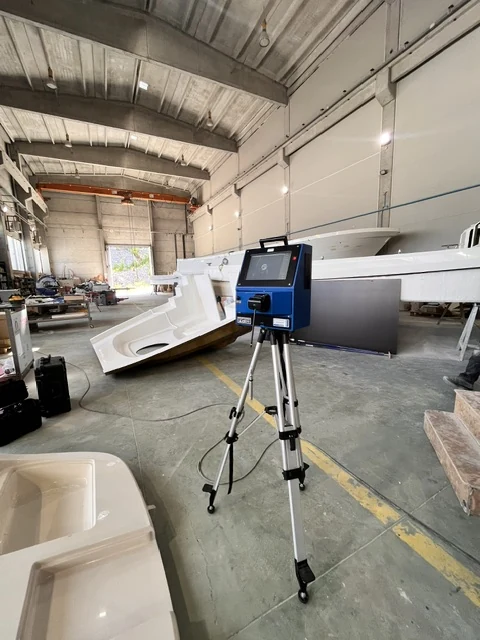
Measuring and digital templating
Accurate templates are the difference between a deck that fits and a deck that has to be re-cut.
01
How digital templating works
A template is a full-size record of the deck’s geometry: every edge, every fitting, every change of angle, accurate enough that a panel cut from it fits, with only the last details adjusted by hand on board.
We take it digitally, on site. The deck is recorded as a set of coordinates rather than as a physical pattern, so nothing stretches, nothing shrinks in transit, and nothing has to be rolled up and posted. The file goes straight to the machine that cuts the planks.
The visit itself is short. What we need is access to a dry deck and, where possible, the fittings either removed or clearly marked: a template taken around a fitting that is about to move is a template of the wrong deck. We aim to be on board at the earliest possible opportunity following confirmation of the booking.
If your vessel is located a long way from us, you may either take the templates yourselves, or we can arrange to visit the vessel wherever required.

02
Sending your own templates
Plenty of customers template their own deck, and there is nothing wrong with it. A careful template made in a shed produces a better deck than a rushed survey. What it needs is discipline about a few things that are easy to get wrong and impossible to correct later. Templates are not the only route: if the builder allows it, the factory drawings of the deck work too, and so do your own drawings as DWG or DXF files.
Template material and marking
Use a material that does not move: thin ply, hardboard or rigid template plastic. Cardboard and paper absorb moisture and change dimension between your deck and our workshop, and by the time that shows up, the panels are already cut.
Build the template in pieces and join them on the deck rather than forcing one sheet around a curve. Mark every joint so the pieces can only go back together one way.
Mark on the template itself, not on a separate note. Write which way is forward, which face is up, and which vessel it belongs to. Templates arrive here unlabelled more often than you would expect, and an unlabelled template of a symmetrical deck is worth nothing.
What every template must show
- The vessel, and which part of the deck this is.
- Which way is forward, and which face is up.
- Every fitting, hatch and drain, marked in its final position.
- The finished edge you want, not the edge of the substrate.
- Where the plank run should follow the sheer, if you have a preference.
- How the pieces join, if the template is in more than one part.
03
Accuracy and tolerances
A prefabricated deck is cut to the template, not to the boat. That is the whole point of the method, and it is also its only real risk: an error in the template is reproduced exactly, in teak, at full size.
Boats are not symmetrical, and they are not the shape the drawings say. A deck faired by hand thirty years ago is a one-off, and a template taken from one side and mirrored will not fit the other. Template both sides.
Where a panel meets a fixed edge (a coaming, a toe rail, a hatch surround), we build in a margin to be trimmed on fitting rather than cutting to the line. It is easier to take material off on board than to explain a gap.
If a template arrives that we do not trust, we say so before cutting. Re-templating costs a visit. Re-cutting costs a deck.
Arrange a templating visit
Tell us the boat and what it needs. We quote per vessel, not from a price list.