
Teak vs synthetic decking: an honest comparison
We make real teak decks. That makes us the wrong people to ask for a neutral opinion, so here is the comparison with our bias declared, and the cases where we would tell you to buy synthetic instead.
The short answer
Real teak costs more, lasts as long as its thickness allows, and can be renewed by sanding. Synthetic costs less, needs almost nothing done to it, and cannot be renewed: when it is worn, it is replaced. If the vessel is maintained and the deck is part of its value, buy teak. If it is worked hard and nobody will maintain it, buy synthetic. We make teak, and we still say that.
REAL TEAK
When only real teak works
- A yacht where the deck is part of what the buyer is paying for.
- A vessel that will be maintained properly for decades.
- Complex geometry where planks must follow the sheer.
- An owner who wants the deck renewable rather than replaceable.
- A refit where the original deck set the standard to match.
SYNTHETIC
When synthetic is the better choice
- A charter boat that gets hard use and needs to look the same in year five as in year one.
- A tender or RIB where weight matters more than appearance.
- A budget that does not stretch to teak of a thickness worth fitting.
- An owner who will not commit to any maintenance at all.
- A vessel operating where sourcing certified teak is a compliance problem.
Side-by-side comparison table
| REAL TEAK | SYNTHETIC | |
|---|---|---|
| Cost to buy | Higher | Lower |
| Expected lifespan | Decided by thickness | Fixed, not renewable |
| Annual maintenance hours | Cleaning, occasional sanding | Cleaning only |
| Surface temperature in sun | Cooler underfoot | Warmer underfoot |
| Grip when wet | Good | Good |
| Repairability | Plank by plank | Section replacement |
| Effect on resale | Expected on larger yachts | Accepted on working boats |
| Environmental documentation | FSC chain of custody | Manufacturer declaration |
01
Cost compared over the life of the deck
Real teak costs more to supply and fit than synthetic. On the day of purchase synthetic wins, and it is not close. Both are quoted per vessel, so the comparison that matters is not between two price lists.
The comparison gets more interesting over time, and it turns on one thing: teak can be renewed and synthetic cannot. A teak deck of decent thickness can be sanded several times across its life, and each sanding returns it to something close to new. A synthetic deck cannot be brought back at all: when it is worn or faded, the only remedy is another one.
So the real question is not what each costs, but how many times you will buy it. Over a long ownership of a well-maintained boat, teak can work out level or cheaper. Over a short ownership, or on a boat that will not be maintained, synthetic is cheaper by a distance and stays that way.
There is one figure we would not build a decision on: the price of a thin teak deck. Teak below a thickness worth sanding costs nearly as much to fit as a thick one and gives you a fraction of the life. If the budget only reaches thin teak, synthetic is the better buy, and we would say so on the phone.
02
Lifespan and how each one ages
They do not age in the same way, and the difference matters more than the numbers do.
Teak ages by wearing and by weathering. Left bare it silvers to grey, which is a surface effect rather than damage. Underneath it is the same timber. The real clock is thickness. Every sanding takes a measurable amount, and when the planks reach the seam line the deck has reached its end regardless of its condition elsewhere. A teak deck therefore ends at a point you can predict and, to a degree, control.
Synthetic ages by wearing and by fading. The wear is at the surface and cannot be renewed, because there is no fresh material underneath: the colour and the texture are the product, not a finish over it. UV takes the colour gradually, and unevenly where covers and equipment shade some areas and not others.
The practical difference shows up in year twelve. A maintained teak deck can be sanded and look new. A maintained synthetic deck looks like a twelve-year-old synthetic deck, because there is nothing to take back to.
Against that: a neglected synthetic deck at year twelve is usually still serviceable, and a neglected teak deck at year twelve is often finished. Neither material is more durable in the abstract. They fail differently, and they reward different owners.

03
Heat, grip and comfort underfoot
This is the difference people notice first and describe least accurately.
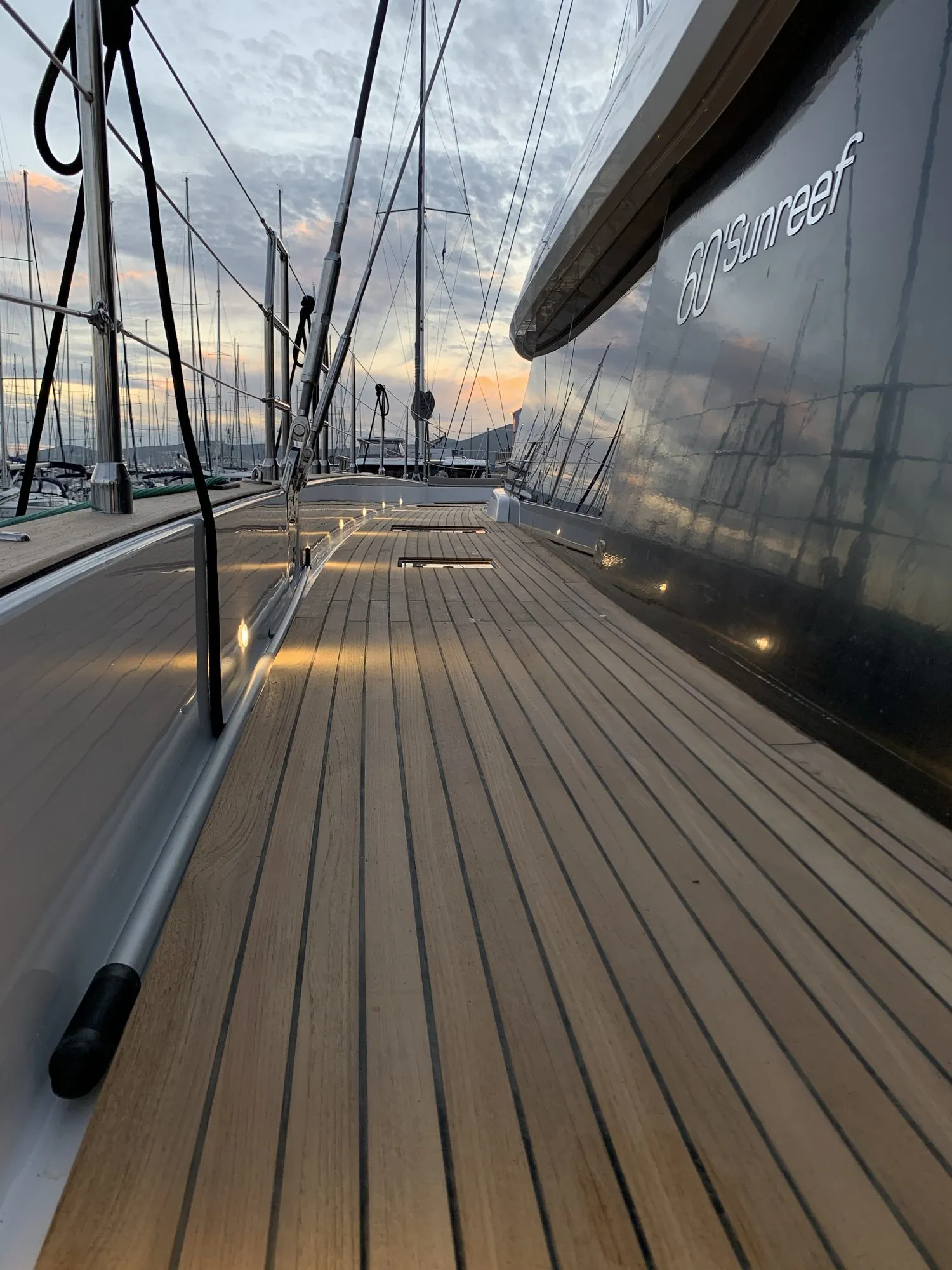
Teak runs cooler in direct sun than synthetic decking does. Both get hot on a still afternoon in August; the gap between them is real, and it is the most common reason an owner who has had both goes back to teak. On a boat used barefoot in the Mediterranean it is not a detail.
Grip is closer than the marketing on either side suggests. Wet teak with open caulk seams grips well. Modern synthetic decking is textured and grips well too. What varies more than the material is the seam pattern: narrower planks and more seams mean more grip on both. Neither is a safe surface once it is covered in sunscreen.
Comfort is partly heat and partly what the surface does underfoot. Teak over a solid deck is firm. Some synthetics are laid over a foam backing and feel softer, which some owners prefer and others find spongy.
If you have not stood on both in the sun, do that before deciding. It settles more arguments than any table does, including ours.
04
Maintenance effort year by year
Synthetic is the low-effort option and there is no honest way around it.
A synthetic deck wants washing. That is close to the whole list. It does not stain from fuel or wine the way teak does, it does not grow mould in the seams, and there is nothing to sand, seal or oil.
Teak wants washing too, and washing done correctly: across the grain, soft brush, mild cleaner. Done that way a teak deck can go years between sandings. Done with a hard brush and a strong cleaner it needs sanding sooner, and each sanding shortens its life. More teak decks are damaged by enthusiastic cleaning than by neglect.
Teak also wants its seams watched. A lifted seam is a cheap repair and an expensive thing to ignore, and the inspection takes minutes.
So the year-by-year comparison is not effort against effort. It is a small amount of correct effort, on teak, against almost none on synthetic. An owner who will do the small amount gets a deck that renews. An owner who will not should buy synthetic and be happier.
05
Effect on resale value
On larger yachts, teak is expected. A vessel in a class where every comparable boat has a teak deck is marked down for not having one, and a tired teak deck is marked down further than a synthetic deck in good order. Brokers will confirm that faster than we can.
Below that size the effect fades, and then reverses. On working boats, tenders, RIBs and hard-used charter boats, synthetic is accepted and in some markets preferred, because a buyer reads the deck as maintenance they will not have to do.
The useful question is not which material a buyer prefers, but which one your buyer will read as evidence. On a yacht, a sound teak deck says the boat has been looked after. On a charter boat, a synthetic deck that still looks right after five hard seasons says exactly the same thing.
A neglected deck of either material tells a buyer what they need to know about the rest of the boat.